Case · Yong Xin Ceramics · 2026
We translated the factory’s numbers into the partner’s language.
A B2B partner brand book for a ceramic tile factory: so dealers, importers, developers and architects present the brand the same way and decide faster.
Task
What the task was.
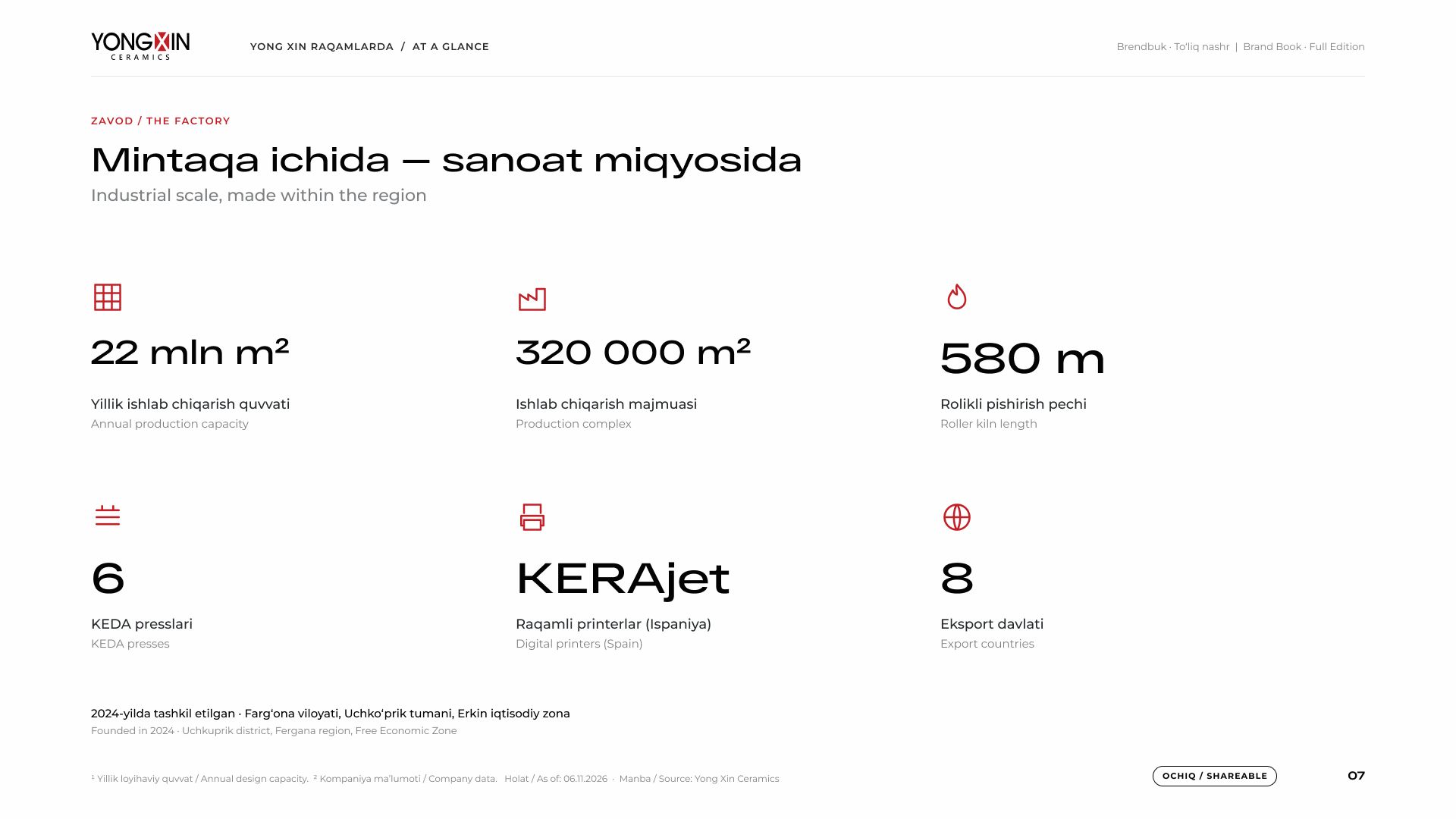
Yong Xin is a ceramic tile factory founded in 2024 with a capacity of 22 million m² per year. The task: gather the factory’s technical evidence into one system for B2B partners — so partners present the brand the same way and speak with one message alongside the sales team.
- 5partner segments — each with different decision criteria
- 8export countries — the document was needed in UZ and EN
- 3business tasks: fast decisions, consistent look, one message
- 22M m²annual capacity — this scale had to be shown to partners with evidence
Approach · Decision architecture
What was done in five stages.
- 01
Segmentation
We divided partners into 5 segments: dealer, importer, developer, contractor and architect. For each, we defined the need, decision criteria, key message, proof and tone.
- 02
Messaging system
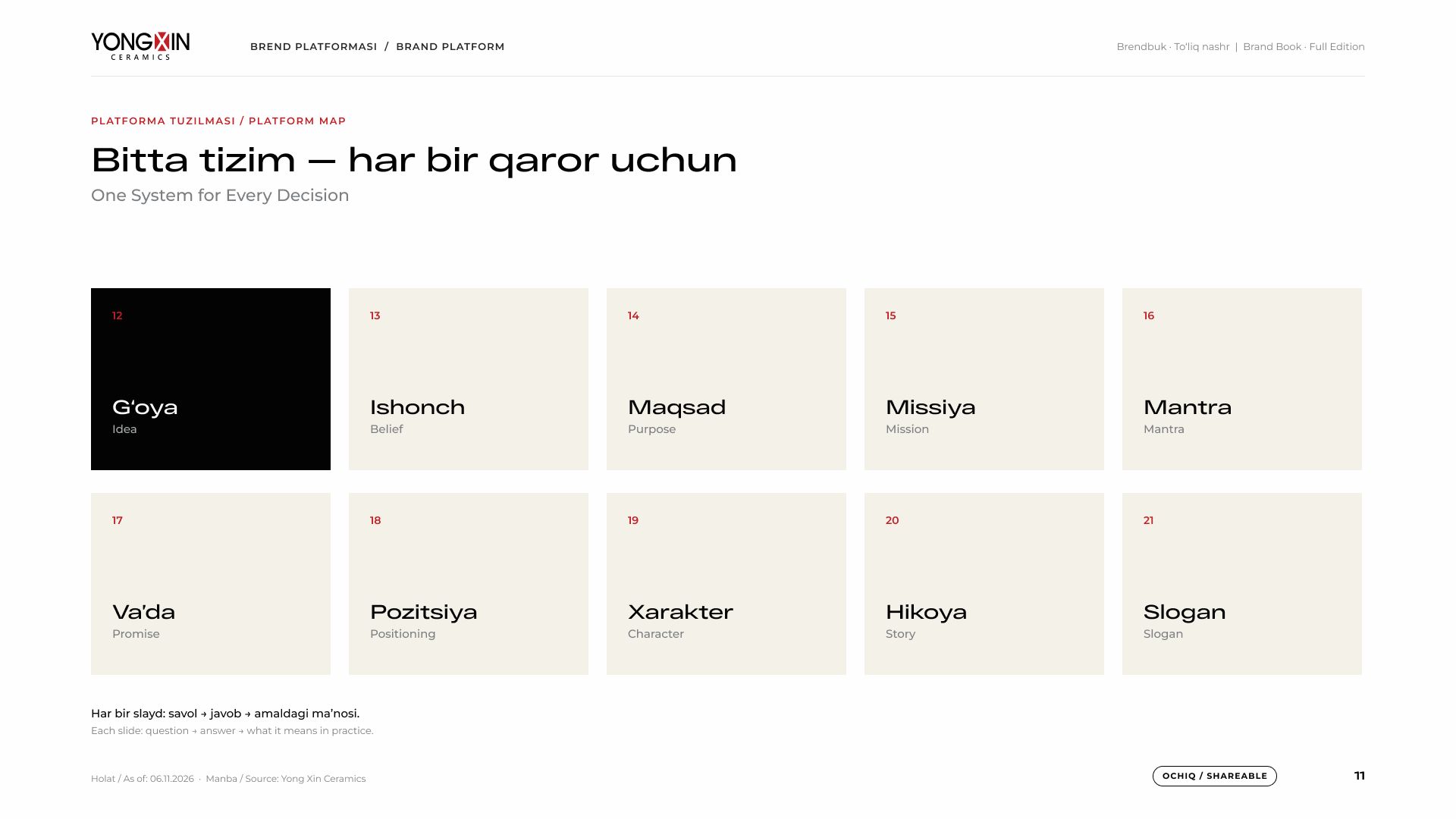
A message house was built: the slogan on the roof, and four pillars — measurable quality, scale, design and technology, partnership. Every claim is backed by a number, so the document works even where there is no sales manager.
- 03
Identity
The new logo became the primary mark. The old seven-winged symbol was kept as a pattern: the brand was refreshed without losing its familiarity. Red is the only accent colour; in B2B materials it never exceeds 10% of the area.
- 04
Partner rules
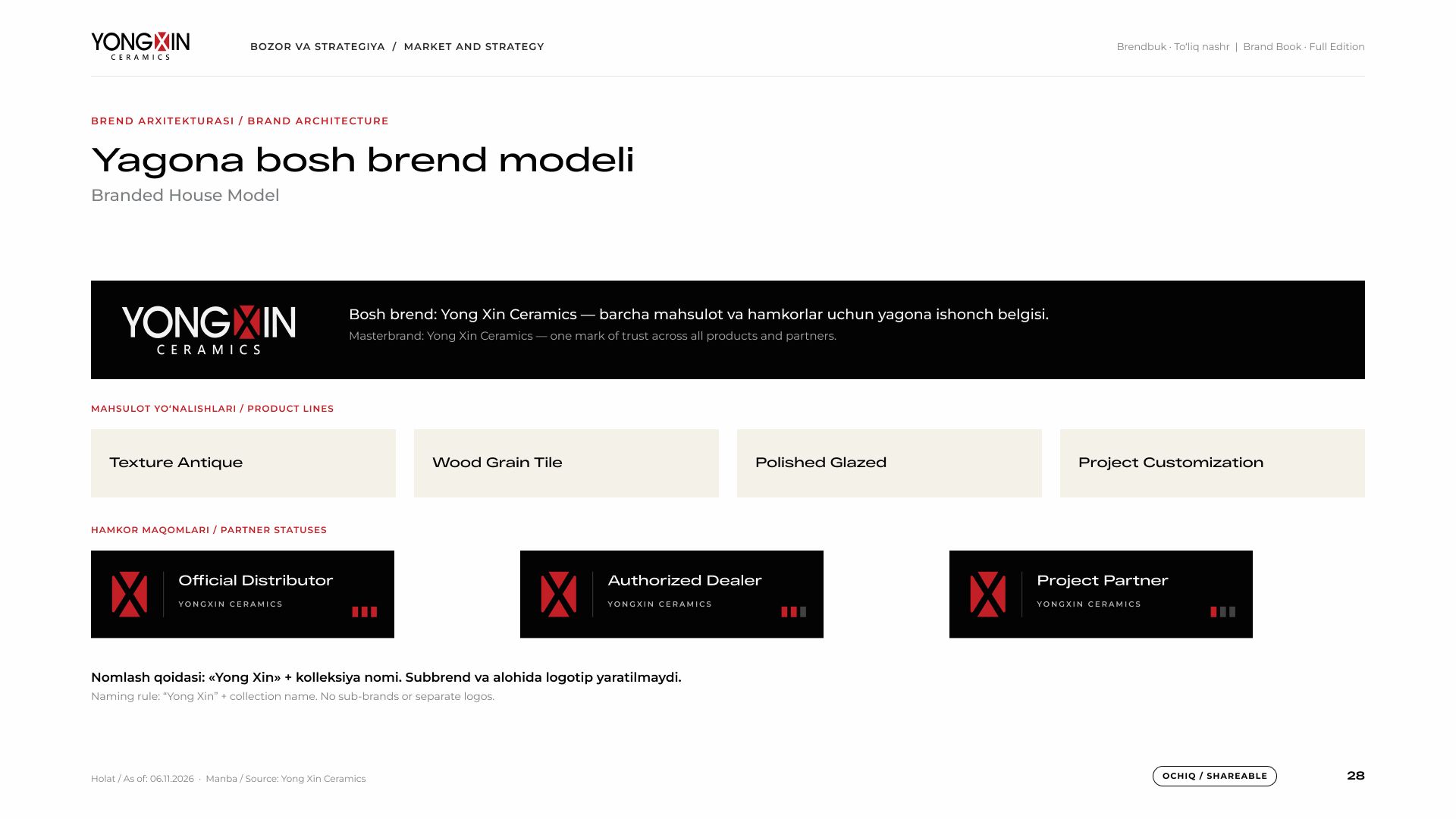
Three partner statuses — Official Distributor, Authorized Dealer, Project Partner — with co-branding rules and an approval process were defined. Partners present the brand the same way, without altering it.
- 05
Rollout
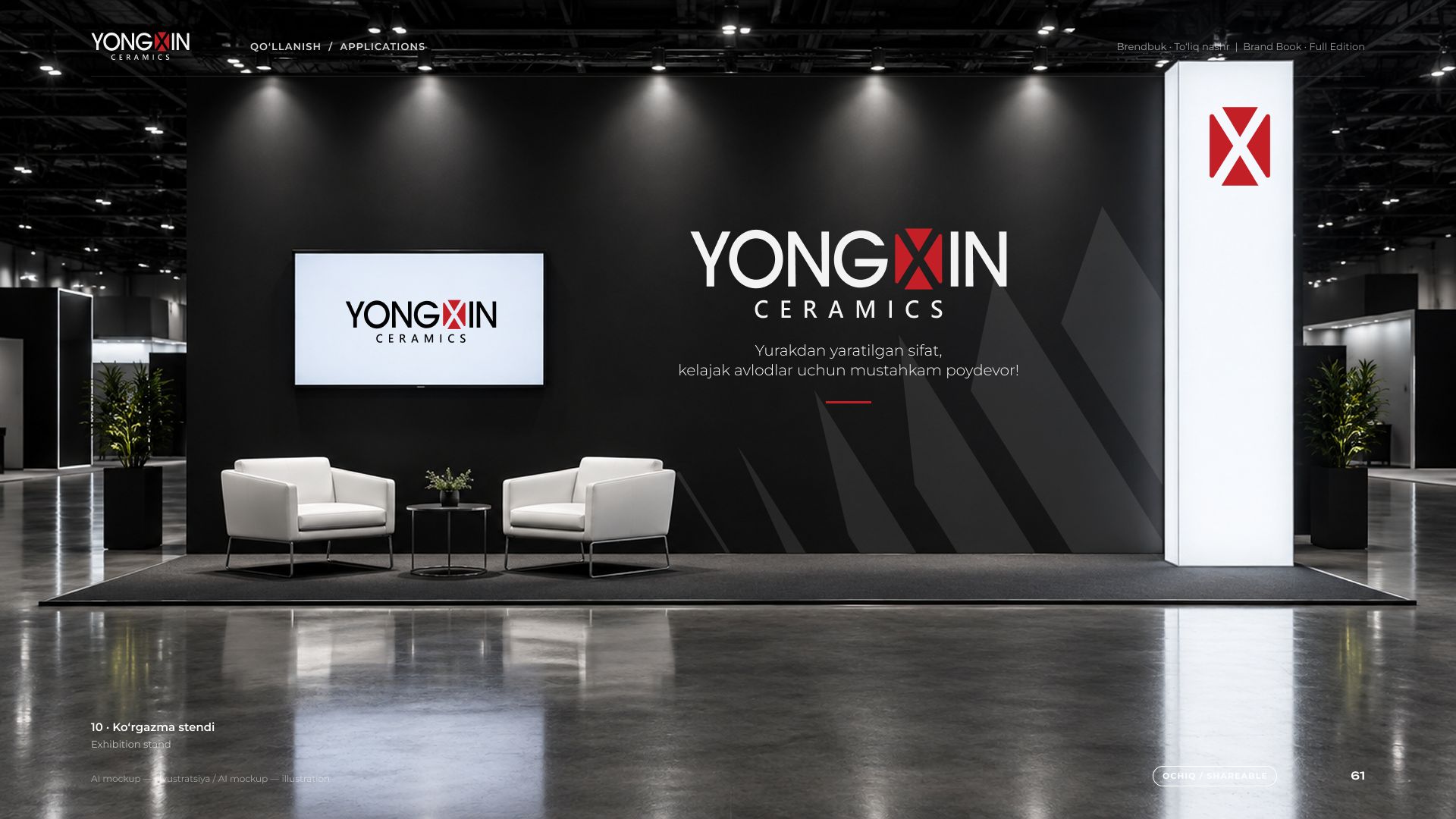
The brand book was produced in Figma and as a bilingual PDF. Partner materials were planned by priority — technical sheet, catalogue, presentation, stand — and the rollout was split into a 30–60–90 day plan.
Based on: J. Romaniuk, “Building Distinctive Brand Assets” (2018); L. Binet, P. Field, “The B2B Effectiveness Code” (LinkedIn B2B Institute, 2019); Gartner, “The B2B Buying Journey”.
Result
In numbers.
5new B2B partners · first 3 months
5 new B2B partners in the first 3 months — the result of the brand platform, the annual strategy and work with the sales team. The brand book gave the sales team and partners one language: every segment finds a numbers-based answer to its question, and there are ready rules for presenting the brand consistently.
Source: Yong Xin Ceramics, confirmed data · 2026
- SEGMENTS5segments, each with its own message, proof and tone
- MESSAGES4pillar messaging system: every claim backed by a number
- STATUSES3partner statuses and co-branding rules
- LANGUAGESUZ / ENbilingual brand book: Figma and PDF
From the work
From the B2B brand book pages.
Mirjalol first found the real problem: we had both the product and the capacity, but marketing, sales and partners were all saying different things. He created the brand platform and the B2B brand book, put marketing into a system, led the team around a single plan and trained our sales team. Today our sales, marketing and partners work with the same message and the same standard.
 Mavlon AlimovCEO, Yong Xin Ceramics